Sunday, 7 August 2016

Letters from Grand Prix personalities

© Patrick O’Brien. Nothing from this page can be used, saved or reproduced without the permission of Patrick E. O’Brien.


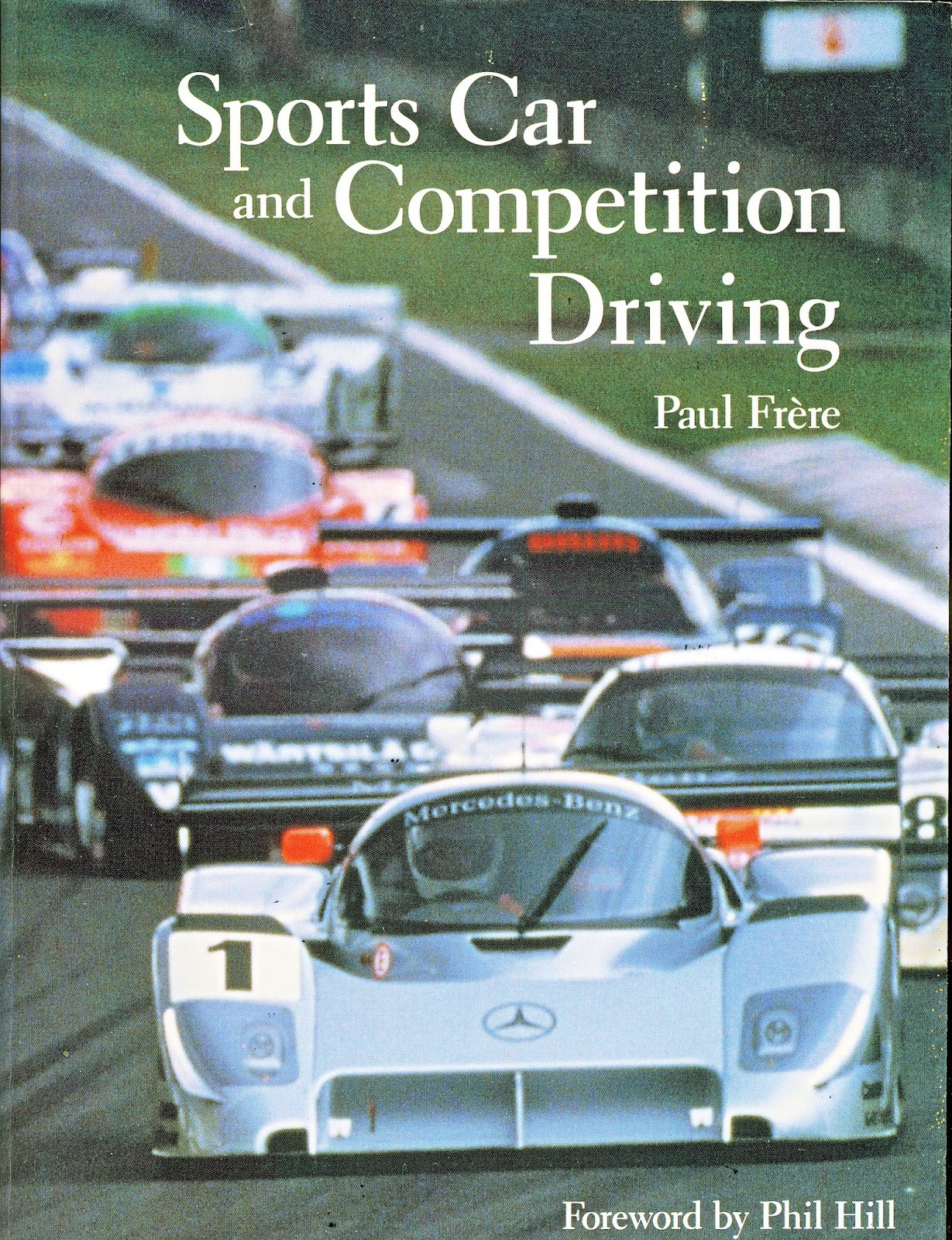
My wife and I met Paul Frere at East London in December 1994 when selling my 1994 book there. He won the 1960 South Africa Grand Prix as well as le Mans for Ferrari. He drove for the Ferrari GP team when Fangio was there, and finished second in the 1956 Belgian Grand Prix! A nicer person one could not meet and low key like his letterhead, good taste all round. I took him for a nighttime drive around Johannesburg in our 159 Alfa Romeo and explained some history, showed him the Munro Drive view. Jolly pleased I did not crunch a gear-change!


Paul Frere note in Belgian GP book, 1994.

 Paul Frere's  inscribed book a sent to me January 1995.


Letter found by me in an old copy of Gerald Rose's 'A Record of Motor Racing: 1894–1908', published by the Royal Automobile Club, 1909; re-published 1949 by Motor Racing Publication.

***

© Patrick O’Brien. Nothing from this page can be used without the permission of Patrick E. O’Brien.

Tuesday, 22 September 2015

1930-1939 SEASON SUMMARIES NOW AVAILABLE

After 12 years of development and refinement from its 2002 inception, my Rating System is being published. The Patrick O’Brien Grand Prix Rating System is divided into 13 volumes, one for each decade of the pre-Formula One era (1894-1949) and Formula One era (1950-2013). The Formula One era, 1950-2013, was published last year [2014]. The ninth decade (1930-1939) is now available – see ‘Buy my Rating System’ above or click on the link below:

The ninth book contains the 1930-1939 seasons, is 165 pages, soft-cover bound and available now online here.

The eighth book contains the 1940-1949 seasons, is 80 pages, soft-cover bound and available now online here.

The seventh book contains the 1950-1959 seasons, is 91 pages, soft-cover bound and available now online here.

The sixth book contains the 1960-1969 seasons, is 82 pages, soft-cover bound and available now online here.

The fifth book contains the 1970-1979 seasons, is 90 pages, soft-cover bound and available now online here.

The fourth book contains the 1980-1989 seasons, is 81 pages, soft-cover bound and is available online here.

The third book contains the 1990-1999 seasons, is 80 pages, soft-cover bound and available online here.

The second book contains the 2010-2013 seasons, is 50 pages, soft-cover bound and available now online here.

The first book contains the 2000-2009 seasons, is 80 pages, soft-cover bound and available now online here.

A section entitled ‘Guidelines for interpreting my Rating System’ is included in all books which briefly explains my System.

Each season is in three sections, Package, Driver and Car, with the whole field rated and tabulated, and text discussing mainly the winners and the front-runners. My own illustrations are used, and reflect a spread of competitors for each season.

For those who are interested further, additional explanations can be found here:


***

Saturday, 15 August 2015

1940-1949 SEASON SUMMARIES NOW AVAILABLE

After 12 years of development and refinement from its 2002 inception, my Rating System is being published. The Patrick O’Brien Grand Prix Rating System is divided into 13 volumes, one for each decade of the pre-Formula One era (1894-1949) and Formula One era (1950-2013). The Formula One era, 1950-2013, was published last year [2014]. The eighth decade (1940-1949) is now available – see ‘Buy my Rating System’ above or click on the link below:

The eighth book contains the 1940-1949 seasons, is 80 pages, soft-cover bound and available now online here.


The seventh book contains the 1950-1959 seasons, is 91 pages, soft-cover bound and available now online here.


The sixth book contains the 1960-1969 seasons, is 82 pages, soft-cover bound and available now online here.


The fifth book contains the 1970-1979 seasons, is 90 pages, soft-cover bound and available now online here.


The fourth book contains the 1980-1989 seasons, is 81 pages, soft-cover bound and is available online here.


The third book contains the 1990-1999 seasons, is 80 pages, soft-cover bound and available online here.


The second book contains the 2010-2013 seasons, is 50 pages, soft-cover bound and available now online here.

  
The first book contains the 2000-2009 seasons, is 80 pages, soft-cover bound and available now online here.


A section entitled ‘Guidelines for interpreting my Rating System’ is included in all books which briefly explains my System.

Each season is in three sections, Package, Driver and Car, with the whole field rated and tabulated, and text discussing mainly the winners and the front-runners. My own illustrations are used, and reflect a spread of competitors for each season.

For those who are interested further, additional explanations can be found here:


***

Friday, 10 July 2015

Review of Roger Smith’s ‘Analysing Formula 1’ (2008)

BOOK TITLE: ANALYSING FORMULA 1
AUTHOR: ROGER SMITH
PUBLISHER: HAYNES PUBLISHING
DATE: January 2008
REVIEW: PATRICK O’BRIEN

This book is an enjoyable read, for Roger Smith is obviously a keen and knowledgeable enthusiast who has delved into racing. Smith claims not to have based his findings on simple wins or win rates and purports to consider the effects of the car and the opposition – factors crucial to gauging driver performance. For someone who is not a journalist, Smith’s text is remarkably proficient. The book bears some uncanny similarities to my analytical book, Grand Prix: A Century of Racing (published by AA Racing, November 1994), in terms of being based on descriptive statistics in the form of simple bar graphs, win rates, rivals wins, grid position vs wins, etc.

THE PROBLEM WITH RANKING DRIVERS
Despite the impressive graphs, matrices and explanations, Smith’s result proclaiming that three drivers ranked at the top – Fangio (career 1950-58), Clark (career 1960-68) and Schumacher (career 1991-2012) – makes one question the methodology. Common sense alone tells us that it is not possible to directly compare drivers across eras, let alone actually rank them. How can it be stated with any certainty that Fangio was better than Schumacher and Clark? Or that these three are better than any of Alonso, Senna, Prost, Lauda, Andretti, Piquet, Stewart, Surtees, Moss or Ascari? There are too many incomparable variables in each career that defy comparative measurement.

In contrast, my Rating System ranks drivers in tiers based on my analysis of their comparative time-based speeds. By my System the fastest drivers of each era rate equal in the first tier, from Fangio, Ascari and Moss through to Prost, Schumacher and Alonso. I certainly would not be able to rank them due to incomparable variables. It is not possible to rank any of the top drivers across eras as greater or as the greatest. They never faced each other and cannot be directly compared.

CAR QUALITY
Smith claims to have taken the quality of the car into account (“it is rare that a great driver can prosper without a great car, or vice versa” (p. 10)), yet some of his findings seem to be results-based data, bolstering the dominance of the drivers who he deemed to be in the ‘top three’, yet he neglects the fact that these three drivers, Fangio, Clark and Schumacher, had superior cars for longer periods of time than most.

When Fangio, Clark and Schumacher did not drive the best cars, their results were not dominant: Fangio-Maserati in 1953, Clark-Lotus in 1961 and 1966 and Schumacher-Ferrari 1996-99 and 2005. Proof that no matter how talented a driver, his performance is largely dictated by the competitiveness of his car.

CAR MODEL VARIATIONS
The many variables in F1 racing make it so complex that any comparative analysis has to be detailed and a methodology consistently applied. Not only does the car largely determine a driver’s competitiveness, but each car model’s performance varies on different circuits, and when upgraded and modified, within and across seasons. Such a complex set of variables significantly impacts results. On this score, Smith appears to have made some generalised, sweeping assumptions to inform his analysis.

For instance, the Maserati 250F seems to have been treated as one model, Smith stating that in 1957 Fangio drove the 250F Maserati “entering its fourth season and nearing the end of its competitive life”. The 250F was in fact made in five quite differing versions each with varying levels of performance relative to the front-runners:

● the initial, belouvred 1954 model
● the upgraded, unlouvred and more competitive 1955 version with which Moss won the 1956 Monaco GP
● the ‘low-drag’ 1956 model influenced by the Vanwall’s aerodynamic shape
● the ‘offset’ 1956 model with which Moss won the GP at Monza
● the final 1957 version which Fangio drove to his fifth crown, which was by far the most competitive of the 250Fs in relation to the opposition.

My Rating studies compare on-track time differentials only, and do not rely on wins, results, places, etc. For example, I discovered that the performance between the various Maserati 250F models varied in cases by over 1.0%. Considering that the winning margins (seasonal averages) for championship-winning packages have been 0.2%–0.5%, incorporation of such detailed factors is crucial to any comparative analysis. Fangio’s debut win in the 1954 Argentine GP with the first 250F was unfairly achieved. The Frana and Gonzalez Ferraris had been leading and faster almost throughout,. When Fangio pitted, more than the permitted number of mechanics attended him. Ferrari protested and slowed their two cars. Fangio swept past and his win was wildly applauded and the officials did nothing about Ferrari’s legitimate protest. Yet this win would have contributed to Fangio’s tally… In 1957 Fangio was driving the fastest car of the season, and the most competitive of all 250Fs; it most certainly was not ‘nearing the end of its competitive life’ as Smith asserts. Fangio enjoyed a wide margin of car superiority over the rival Vanwall and Lancia-Ferrari cars in 1957. Bare race results do not distinguish such qualitative ‘quirks’ of racing performance behaviour.

Similarly, Smith treated the Lotus-Cosworth 49 as one model. It was in fact built in three basic versions of widely varying perfromance in relation to its rivals:

● the original Type 49 of 1967 and driven to Clark’s last win at Kyalami in 1968;
● the longer wheelbase 49B of 1968, later fitted with aerofoils, which Graham Hill drove to his second title; my calculations showed this car to have been a whopping 1.5% faster than the first short-wheelbase version.
● the final 49C driven until early 1970 by Rindt.

There is no indication in Smith’s book that the widely differing performance of these Lotus 49 variations has been factored in.

One significant model variation clearly ignored by Smith is the 1989 McLaren-Honda MP4/5. Smith states of Prost and Senna: “over those two seasons 1988 and 1989, they started 32 races together in identical machinery”. This was only true of 1988; for 1989 Senna was provided with superior engines, such that, from parity race performance in 1988, Prost was bizarrely 0.3% slower in 1989 and in qualifying suddenly a whole 1.0% slower than in 1988. Only Prost’s car set-up skills and sensitive, intelligent racing genius reduced the huge 1.0% qualifying gap to 0.3% for the races. At the time, nobody in the McLaren-Honda team knew about this engine favouritism – except of course Honda who did not divulge that they were favouring Senna. Prost stated: “No way is a driver suddenly a second a lap slower”. Prost’s complaints about Senna having more power were dismissed by the British press as ‘whingeing’. Years later, one of Honda’s engineers confessed that Honda had indeed favoured Senna over Prost. Smith has not differentiated the data for this 1989 season, which invalidates half of the information used in the Senna-Prost comparison, during the only two years in which they were team-mates.

The varying performances of models across seasons can significantly affect driver results. For example, when the dominant 1978 Lotus-Cosworth 79 competed in 1979, its performance relative to the front-runners was way below what it had been in 1978. Similarly with the 312T3 Ferrari in 1979, the Ferrari F2004 in 2005 and many other existing models when carried over into a new season. Smith’s work glosses over such distinctions, jeopardising the validity of his measurement methodology and his findings.

DRIVER CAREER STAGES
Another generalised statement that casts doubt on Smith’s data informing his rankings is the following: “Moss was Fangio’s equal at best”. Yet when Moss and Fangio raced the Maserati 250F/57 as team-mates at Buenos Aires in January 1957, Moss outqualified Fangio by 1.1 seconds! In the race and after an unscheduled nine-lap pitstop for repairs, Moss made up two laps on “The Old Man” (Juan Fangio). This was not indicative of equals! This highlights another variable that needs to be taken into account: driver competitiveness is not consistent over a career, even for the best drivers. Usually rookies build up to their peak after three to five seasons, and older men’s speed tapers towards career end. This was why Moss was faster than Fangio by 1957. As Niki Lauda said of his own last two seasons 1984-1985: “You cannot go at it as you did when young” and Prost of his 1988-1989 seasons: “Ayrton [Senna] was faster than me; after ten years you no longer go flat-out” (quotes paraphrased from magazine articles). Much depends on which stage of their respective careers drivers faced each other. This factor also precludes direct driver comparisons.

COMPETITIVE TEAM-MATES
Roger Smith correctly states: “Senna’s rivalry did for Prost’s aspirations just as Prost did for Senna” – that is, they spurred each other on. Yet the crucial factor of competitive team-mates does not seem to have been taken into account with the three whom he finds superior to all: Fangio, Clark and Schumacher. Uniquely all three were spared competitive team-mates for most seasons throughout their careers. This means that their win rates and other statistics would be superior to those of drivers who had tougher team-mate competition, such as Senna and Prost, Piquet and Mansell, Hamilton and Rosberg or Moss and Brooks.

Fangio’s most competitive team-mates were Farina in 1950, Gonzalez in 1953 and Moss in 1955. However, at age 44, Farina was too old to really threaten Fangio, being 0.6% slower on season-average qualifying times, while the two younger men – Gonzalez and Moss – had too much deference for Fangio, who was almost a generation older, to really challenge him. In sum, Fangio was never seriously challenged in-house. Similarly with Clark; apart from 1960 when Surtees drove part-time for Lotus, Clark’s Lotus team-mates were notoriously way off-pace, not only as drivers but in equipment; the Number Two Lotus cars during Clark’s heyday were neglected by Colin Chapman (owner of Lotus and brilliant designer) and consequently so much slower and drastically unreliable. Lotus was really a one-man team. Similarly Schumacher was unchallenged, having self-selected his team-mates throughout his career, making sure they were not too competitive a threat.

There is no doubt this lack of in-house team-mate threat inflated Fangio’s, Clark’s and Schumacher’s results. In this respect their careers were so unlike those strong pairings that diluted each driver’s results, such as: Senna and Prost in 1988-1989, Moss-Brooks 1957-1958, Fittipladi-Peterson 1973, Scheckter-Villeneuve 1979, Prost-Lauda 1984, Mansell-Piquet 1986-1987 and Alonso-Hamilton 2007. How then can one compare the Fangio-Clark-Schumacher ‘sheltered’ career results with those of the other great drivers?

THE OPPOSITION
At least as important as a competitive, unhobbled team-mate are competitive rivals. Fangio, Clark and Schumacher were unable to dominate when they faced other top-rate drivers in good cars.

Fangio
Fangio was fortunate during part of his career that his main rival and driver-equal Ascari was neutralised:

● in 1950 by Ascari’s non-competitive Ferraris in 125C2 and 275 forms;
● in contrast was 1951 when the Ascari/ Ferrari package was almost as fast as the Fangio/Alfa Romeo and scored two wins to Fangio’s three.
● In 1953 Fangio’s Maserati was slower than Ascari’s Ferrari and Fangio managed just one, perhaps fortuitous, win at Monza.
● In 1954 Ascari missed most of the season, his Lancia only appearing for the final race at Barcelona, where he out-qualified Fangio’s Mercedes-Benz by a whopping 1.0 second and led until clutch failure. Earlier in the 1954 season Ascari had twice been released for one-off drives, in a Maserati 250F for the British GP and a Ferrari 625 in the Italian GP at Monza, which latter he led for 49 of the 80 laps in a titanic struggle with Fangio’s Mercedes-Benz. On both occasions Ascari’s cars failed to finish.
 Ascari crashed fatally after the first two races of 1955, thereby removing one of Fangio’s two greatest rivals.
● Fangio’s good fortune extended to the 1956 and 1957 seasons when his then strongest driver rival Moss was hampered by his slower Maserati and Vanwall cars.

These variables do not detract from Fangio’s undoubted ability, but they certainly boosted his results and negate valid and direct driver comparison with Ascari and Moss.

Clark
Clark was similarly smiled upon by good fortune and fate. From 1960 to at least 1968, his main driver rival and equal was in fact John Surtees. Barely acknowledged in Smith’s book, Surtees was the most hampered-by-poor-machinery great driver of all. Except for his initial four rookie appearances in a Lotus-Climax 18 in 1960, when he managed one second place and was leading Moss’ similar car before crashing on slippery tramlines in Oporto, and the first two events of 1966 with the Ferrari 312/66, Surtees drove inferior cars for the rest of his 13-year career! Consequently, Clark drove in a ‘partial vacuum’ and his results cannot be validly compared with Surtees’.

Schumacher
Michael Schumacher enjoyed the longest competitive career of any Formula driver to date, until he retired in 2006 – a span of 16 years. For the first three seasons, Schumacher did not have the fastest car, but still scored a few wins. In early 1994, Schumacher’s Benetton-Cosworth package was virtually equal in speed to Senna’s Williams-Renault package; after Senna’s death, and for the remainder of the 1994 season, the Schumacher/ Benetton-Cosworth was 0.5% clear of Damon Hill’s Williams-Renault package. For 1995 this advantage was reduced to a still comfortable 0.3% over Hill’s Williams-Renault package. No surprise then that Schumacher won titles in both years. Schumacher’s initial Ferrari season, 1996, saw his package 0.3% slower than Hill’s Williams-Renault; from 1997 to 1999 he was on par with Villeneuve’s Williams-Renault and then Hakkinen’s McLaren-Mercedes. He was not dominant in these four seasons. Just as with Fangio, Ascari, Clark, Andretti, Stewart, Lauda, Prost and Senna, Michael Schumacher only dominated when he had the best car. As with any driver in an off-pace car, Schumacher suffered in 2005, managing a farcical, single win at Indianapolis. For 2006, Schumacher and his Ferrari were 0.1% down on Alonso’s Renault, but as always Schumacher drove brilliantly to even-score with seven wins. Schumacher’s career reads very much like Clark’s and Fangio’s in terms of package competitiveness; all three enjoyed several seasons of car-team dominance. Which negates direct comparison with others who did not.

INEVITABLE STATISTICAL RESULTS
Roger Smith claims to have measured or quantified driver results based on the three elements that affect driver results: car, team-mate and opposition. However, Smith’s statistics-based data would inevitably favour his top three drivers – Fangio, Clark and Schumacher, who score higher than any of the other top drivers. How can one say Fangio is better than Stewart or Prost, for example? They never raced each other therefore they cannot be compared. Fangio’s 1954-55 team-mate Karl Kling told how Moss was much better at setting up the car, that Fangio was not interested; how would this benefit Stewart, Lauda and Prost who were famed for their knowledge of the technical side of F1? Would Fangio’s natural talent have been enough against these three? There are no absolute answers but certainly doubts over claiming who was greater.

Below, I set out some of my own statistics under the titles Smith mentions as relevant to driver assessment:

1. Percentage of career without top-rate team-mate: Fangio and Schumacher 100%, Piquet 92%, Clark 90% , Ascari 83%, Moss and Senna 82%, Stewart 78%, Prost 46% and Lauda 38%.

2. Percentage of career without top-rate rival package: Fangio 29%, Ascari, Clark, Schumacher 25%, Stewart 22%, Senna 18%, Lauda, Prost 8%, Moss and Piquet 0%.

3. Percentage of career driving multi-winning car (my definition being a minimum total of 3 wins per season by all team drivers): Fangio 85%, Senna 80%, Prost 78%, Schumacher and Stewart 75%, Clark 62%, Ascari 60%, Lauda 53%, Moss 45%, Piquet 30%.

Any results- or statistics-based method would place Fangio, Clark and Schumacher at the top, due to the three major factors that Smith mentions: car, team-mate and opposition. In contrast, Senna-Prost 1988-1989, Mansell-Piquet 1986-1987, Scheckter-Villeneuve 1979, Fittipaldi-Peterson 1973, Hamilton-Button in 2012, Hamilton- Rosberg 2013, were close-matched team-mates and therefore took wins off each other i.e., they ‘cancelled out each other’s results. One could say that Senna and Prost were racing against Schumacher in 1990-1994, for example, therefore it *is* possible to compare Schumacher with Senna and Prost. However, they were in different cars (Schumacher in a Benetton-Cosworth up until 1995 and thereafter in Ferrari; Senna in the McLaren-Honda and Prost in Ferrari and Williams-Renault). The incomparable cars meant that Schumacher was not directly comparable to Senna and Prost. In contrast, my Rating System separates the performance of the driver from the performance of the car, in order to compare drivers directly. 

In my opinion, Smith’s analysis is fundamentally results-based, proven by his ranking Fangio, Clark and Schumacher at the top. The three top drivers who never had an equal team-mate, who had superior cars for the longest period, and who enjoyed a greater percentage of their races without strong rivals were: Fangio, Clark and Schumacher!

In contrast, my Rating System identifies those drivers who were the fast but whose results were stunted through not having a fast enough car – prime examples being John Surtees (career 1960-1972) and Stirling Moss (career 1951-1961).

In addition, the incomparability of careers that are individually and intrinsically so disparate, make direct driver rankings – such as those Smith has attempted – impossible.

GRID POSITIONS AND WINNING
This very interesting and potentially informative topic has been treated in a surprisingly loose and incoherent manner for a professional statistician such as Roger Smith. Smith computes the number of winners from “the front row”! The front row in early times (1950s-early 1970s) consisted of three, four or five cars, whereafter it reduced to three and then to two cars. For the past 40 years or so, the front row has really been one car on the so-called staggered grids. Consequently Smith’s grid time intervals would show wide variations .He therefore compares apples and oranges, thereby nullifying comparative analysis. To be more accurate, the grid should have been segmented based on time- or percentage-intervals. By contrast, the method used by Smith is spurious.

CONCLUSION
Would Schumacher’s renowned team-involvement skills and other out-of-cockpit management overcome Fangio or Clark, or would their respective natural talents have prevailed? What of those other acknowledged car set-up and technical development specialists, Surtees, Stewart, Andretti, Lauda and Prost: how would they fare against Smith’s top three in equal equipment? What of the phenomenally fast and successful Ascari, Moss and Senna? No conclusive answers are possible.

The effect of the car on package performance is far more than that of the driver, unpopular though this fact is in today’s media-driven cult of the hero and the celebrity. Nico Rosberg correctly summed up the perennial and unequal situation in F1 racing (Cape Times, 20 March 2008): “...there are six or seven cars in front that we can’t beat […] That’s just the way it is in F1. It sucks, but that’s the way it is.” As shown above, not even Fangio, Ascari, Moss, Surtees, Clark, Stewart, Prost, Senna or Schumacher can do much about car inferiority when facing other top-rated drivers in good cars.

Unpalatably to many, race results – such as Smith appears to use – have always had far more to do with the lucky timing of driver-car combinations and circumstances than with the popularly perceived but seldom occurring direct, level-playing-field, head-to-head and measurable competition between drivers.

It is therefore not possible to differentiate or to make fine comparisons between ‘Top Drivers’ with any degree of quantifiable and convincing certainty. Smith’s work is definitely a step up in analysis from the popular ‘driver-ratings’ which are characterised by being lineally ranked and scientifically woolly – being grounded in nothing more than emotion and personal opinion. However, Smith’s ultimate conclusions – that Fangio, Clark and Schumacher were the top three Formula One drivers – remain an illogical and unsubstantiated leap.

© Patrick O’Brien. Nothing from this page can be used without the permission of Patrick E. O’Brien.

***

Wednesday, 25 February 2015

2015 update

Since completing publication of the 7 decades of Formula 1 (1950-2013) - now available in 7 volumes on Amazon, I have been getting the 1940s book and 1930s book ready for publication. The remaining 4 volumes (1894-1929) will follow after these two. Thanks for visiting. 

Tuesday, 7 October 2014

RICCIARDO BEATING VETTEL

2014 Daniel Ricciardo
Many people were surprised when Daniel Ricciardo, new Red Bull-Renault team-mate to Sebastian Vettel for 2014, started beating the four-time World Champion. Along with many, I thought that Vettel would soon get back on top. Yet at race 14 this has not happened. Ricciardo has been ahead eight times, in the ten races when both finished, to Vettel’s two. Ricciardo has won three races, Vettel none.

The impression created is of a virtual rookie dethroning a four-time World Champion. Incredible, especially when one considers that Vettel utterly dominated the 2011 and 2013 seasons and scored the most points in 2010 and 2012. His first win was in 2008 and his last came at the end of an exceptional nine consecutive wins at the end of the 2013 season. Vettel had won 39 races, almost as many as Mansell.

Ricciardo by comparison was a relative unknown. He started in F1 halfway through the 2011 season with the backmarker Hispania-Cosworth team, moved closer to midgrid with Toro Rosso-Ferrari for 2012-2013. Ricciardo’s best placings were 18th in 2011, two 9ths in 2012 and two 7ths in 2013. Measured against his team-mates:

2011: Ricciardo ahead in races (when both finished) 4 times to Liuzzi’s 1.
2012: Ricciardo ahead in races (when both finished) 8 times to Vergne’s 7.
2013: Ricciardo and Vergne were equal, each being 5 times ahead in races (when both finished).

Going by these simple stats, it did not seem as if Ricciardo was anything special. Of course the Red Bull-Toro Rosso experts knew more and promoted him to the Red Bull-Renault Team for 2014.

Vettel had been with Toro Rosso since 2007, scored his first win in 2008 and was promoted to the Red Bull-Renault team for 2009. Vettel had looked special from the start in 2007 when he beat the experienced Liuzzi and then drove impressively in a one-off race for BMW, showing well against his fast, experienced team-mate Nick Heidfeld.

Many questioned Vettel’s ability when he defeated his Red Bull-Renault veteran team-mate Webber in 2009 and 2010. However for 2011, 2012 and 2013 he was clearly faster by some margin. Webber was no slouch, proven by his several superb wins, particularly at Monaco and Silverstone. Vettel managed all aspects of his Red Bull-Renault cars superbly, his speed and talent being highlighted by his many late qualifying laps for pole (46 poles in 7 seasons), as well as by his cheeky fastest laps (22 in 6 seasons) set at the end of almost every race, his eye on the record books! This despite his stressed race engineer Rocky urging him to slow down and make sure the car finished!

How then could newboy Ricciardo in 2014 be the faster racer for 8 of the 14 races to date, while Vettel finished ahead only twice?

Experts attribute Vettel’s falling from top-rate form to his being uneasy with the lack of rear downforce exiting corners. This was due to new technical regulations which reduced the aerodynamic use of rear bodywork diffusers. Another part of the reason is that Ricciardo has obviously taken a step up, and is at home in the car as well as displaying sound racing maturity. According to Toro Rosso team principal, the astute and experienced Franz Tost, Vettel managed a big step up in performance for 2011. This I noticed by my driver-rating against his then team-mate Webber, compared with 2010.

This exceptional phenomenon of a new, younger driver Ricciardo, upstaging a talented old hand like Vettel: has it happened before? A look back through Grand Prix history is always informative for placing things in context.

2008 Lewis Hamilton
2007 HAMILTON EQUALS ALONSO

For the 2007 season it was an actual F1 rookie, Hamilton who equalled his twice World Champion team-mate Alonso at McLaren-Mercedes. Alonso had been racing since 2001 and was into his 6th season when he joined McLaren-Mercedes for 2007. He had won back-to-back titles with Renault in 2005-6 and in 2006 had tellingly gone head-to-head with Michael Schumacher in virtually equal cars, Renault and Ferrari respectively. Alonso scored 6 poles to Schumacher’s 4 and won the races narrowly with 7 wins to 6. There was no doubting Alonso’s ability.

Yet from the first race for McLaren-Mercedes in 2007, the 22-year-old rookie Hamilton performed close to the 26-year-old double Champion Alonso. Alonso was ahead 9:6 in the races when both finished, but Hamilton scored 6 poles to Alonso’s 2, each won 4 races. A phenomenal performance for a rookie.

Contemporary Formula One commentators hailed this as the greatest rookie feat of all time.

Grand Prix racing however went back a long way before the inauguration of the Formula One Championship in 1950. It can be said to have started in 1894, and included over 300 top-class races until 1949. Having measured and compared each of the 2000-plus competitors from 1894-2013 on a consistent basis in my Rating System, some interesting phenomena were revealed.

1934 Guy Moll
1934 MOLL CHALLENGES VARZI AND CHIRON

The closest pattern of similarities to the Ricciardo-Vettel situation of 2014 occurred 80 years ago in 1934. The Alfa Romeo team had dominated since 1932, with top drivers Nuvolari and Caracciola in 1932 and Nuvolari and Chiron in 1933. For 1934 Nuvolari had left, and the team were led by Varzi and Chiron, who could be said to have been the equivalent of Alonso and Schumacher in 2006 or Alonso and Hamilton in 2014. Varzi was 24 in 1934, an ex-motorcycle racer who Enzo Ferrari reckoned ‘was Nuvolari’s equal from 1930 to 1934’. Chiron was 33 and as fast as both Varzi and Nuvolari.

Young Algerian Guy Moll started Grand Prix racing in 1932 and showed enough promise to be invited to join the strong Alfa Romeo team for 1934 at age 25.
Just as Ricciardo was to do in 2014, Moll was instantly fast, running second behind Chiron at Monaco until Chiron slid into the barrier at the Station Hairpin on the 98th lap of 100, allowing Moll past to win. At the high-speed Tripoli race Moll almost passed winner Varzi on the last lap, just failing by 0.2- second at the flag. The next race was at the even faster banked autobahn circuit AVUS, outside Berlin. Varzi and Chiron had the standard, open-wheel-bodied Alfa Romeo 8C2900Bs, while Moll was given one with an aerodynamically-shaped body that was 20 kmh/12 mph faster on the straights. After the faster Auto-Union had retired by lap 10 of 15, Moll took over at the front and beat Varzi by 1m 27s, although not a straight comparison due to Moll’s faster car. This dangerous circuit took some skill where the race average was 206 kmh/128 mph compared with Tripoli’s 186 kmh/115 mph race speed. Next came the Marne GP at Reims, where all drove the standard bodied Alfa Romeos, but Moll was beaten by Chiron into second place by a lap. Initially Varzi and Chiron had battled each other furiously for the lead for 41 of the 64 laps until Varzi’s gearbox gave trouble. The next meeting of the Alfa Romeo drivers was at the slow, tortuous Ciano Cup circuit in Livorno. Here Varzi won by 9-seconds from Moll, Chiron not being present.

Tragically the next event at Pescara for the Coppa Acerbo, was to be Moll’s last. Outclassed by the Auto-Union and Mercedes-Benz teams, especially on the 10km/6 mile straight along the Adriatic coast, the Alfa Romeos chased hard, Moll then Chiron running behind the three or four German cars for 5 of the 20 laps. Chiron then went up to third place but his car caught fire during a pitstop. When the German cars pitted, Moll took the lead for laps 10 and 11. Then Varzi took over at the front for laps 12 and 13 until his gearbox failed, allowing the Fagioli/Mercedes-Benz to lead, but chased by Moll in second place from lap 14 onwards. On lap 18 Moll’s car veered off the long, straight at about 260 kmh/160 mph and somersaulted, the driver being killed instantly.

Moll had shown such promise, that Enzo Ferrari likened him to Stirling Moss for his speed and racing presence of mind. His challenging of experienced team-mates Varzi and Chiron was similar to Ricciardo’s of Vettel, in that neither was arookie, Moll being into his third season, Ricciardo his fourth. Doubtless had Moll lived, he’d have been even more competitive in 1935, his fourth season.

There are several more examples of new drivers challenging and even beating established and more experienced team-mates.

1936 Bernd Rosemeyer
1935 ROOKIE ROSEMEYER CHALLENGES VARZI

In 1935 now-veteran Varzi, ‘Nuvolari’s equal’ according to then team-manager Enzo Ferrari, was into his eighth season, but was in for another challenge from a young driver when he left Alfa Romeo for Auto-Union. Varzi’s brilliance was displayed in his first race in the rear-engined V16 Auto-Union at the high speed Tripoli circuit when he finished a fine second to Caracciola’s Mercedes-Benz, the fastest package of 1935.

For the AVUS race in May Auto-Union veterans Varzi aged 31 and Stuck aged 36 were joined by 26-year-old ex-motorcyclist and Grand Prix rookie Bernd Rosemeyer. This circuit was the fastest of all, being formed by two 10 kilometre/6-mile lanes of a new autobahn, joined by a very steeply-banked turn at one end. Rookie Rosemeyer did well in his heat to qualify behind Stuck who averaged 260kmh/160 mph for pole. On lap 4 of 5 Rosemeyer’s car burst a rear tyre on the banking, but he brought it safely to a stop, which amazed Mercedes-Benz team manager Neubauer.
At the Eifel GP on the Nurburgring Rosemeyer displayed his exceptional talent by leading the race in the rain for the last few laps, only losing narrowly to ‘Rainmaster’ Caracciola’s Mercedes-Benz. In the next three races, the French and German GPs and the Coppa Acerbo at Pescara, Varzi and Stuck were faster than Rosemeyer, who managed a fine second place at Pescara. In the next, the Swiss GP, Rosemeyer finished third, Varzi fourth behind two Mercedes-Benz’s. At Monza Stuck won, Rosemeyer’ s car failed but he took team-mate Pietsch’s car and finished third behind the shared Dreyfus-Nuvolari Alfa Romeo. At the Spanish GP all three Auto-Unions gave trouble, but Rosemeyer did best, struggling in fifth after several pitstops. The season finale at Brno’s Masaryykring, in the absence of the Mercedes-Benz team, saw first Stuck then Varzi lead laps 1-5 and 5-12 of 17 until both cars gave trouble, allowing Rosemeyer past to win.

For a rookie to mix it with such tough, experienced drivers as Varzi and Stuck in the rear-engined V16 Auto-Union team was quite something. Not surprisingly Rosemeyer went on to become the fastest driver by 1937.

1908 Ralph de Palma
1908-1910 ROOKIE DE PALMA CHALLENGES NAZZARO AND WAGNER
Another great driver to be challenged by a rookie was the smooth, refined and fast Italian Felice Nazzaro, who had been driving for Fiat since 1905. He dominated the 1907 season. Yet at the American Grand Prize of 1908, rookie Ralph de Palma led from the start and set the race’s fastest lap, until after a pitstop to change tyres, the spare tyre cradle dragged on the road, dropping de Palma back. Team-mates Wagner and Nazzaro finished 1st and 3rd. Again invited to join the Fiat team for the 1910 American GP alongside Nazzaro and Wagner, de Palma joined in the close, lead-swopping fight between the Fiat and Benz teams. He was leading narrowly going into the last lap when his Fiat cracked a cylinder, allowing six cars past.
De Palma’s talent was obvious, to match and even upstage Nazzaro and Wagner clearly pointed to an exceptional talent. He continued to be a leading grand prix driver until 1921.

1912 David Bruce-Brown
1910-1912: BRUCE-BROWN CHALLENGES HEMERY, WAGNER AND DE PALMA

In the 1910 American Grand Prize 20 year-old rookie David Bruce-Brown joined the Benz team as team-mate to Hemery, the tough, 35-year-old ex-sailor who had debuted in 1905, and American Willie Haupt. In a close battle with the three Fiats, Hemery led laps 1-7 of 20, Haupt laps 9-13 while rookie Bruce-brown took the lead in the last quarter of the last lap to win by just 1.4-seconds after 5-hours and 53-minutes. The best rookie debut of all time?

For 1911 and 1912 Bruce-Brown joined the top-rated Fiat team, with team-mates Wagner, Bragg and de Palma. In the 1911 American GP Bruce-Brown won again, after Wagner and Brag had suffered car trouble. In the epic 1912 French GP, when the small, high-revving 7.6-litre/464 ci Peugeot toppled the big, 14.1-litre/860ci Fiat cars, Bruce Brown led from the start until a fuel line leaked and he ran out at lap 14.5 of 20, allowing the innovative Peugeot to win from Fiat team-mate Wagner.
Despite being such a brilliant driver, still only 22 years old, Bruce-Brown crashed fatally later that year practicing for the Vanderbilt Cup at Milwaukee, after a worn tyre burst. His mechanic Tony Scudelari also died.

1957: MOSS BEATS FANGIO

And now for a more modern pairing, Moss and Fangio for just one race together in the Maserati team for the 1957 Argentine GP. Only after doing my Rating System study in 2002 did I discover this phenomenon: that Moss was actually somewhat faster than Fangio! Sacreligious as it sounds, and despite general consensus that Fangio was supreme in GP cars, I wrote it up in detail elsewhere on my blog.

For the 1957 season opener Moss’s Vanwall team were not ready, and released Moss to drive for Maserati, alongside Fangio. Moss outqualified Fangio by a whole second for pole, but suffered a broken accelerator linkage on the grid. He spent nine laps at his pit for repairs, then charged back out, continually broke the lap record and made up two laps on ‘The Old Man’ who won. Having lost so much time, Moss still only managed to finish eighth.

Hereafter Moss went back to Vanwall for the rest of the 1957 season, which was a slower, more difficult-to-drive car than the Maserati.

According to my rating System, Moss was actually faster than Fangio from 1956 onwards; not surprising considering Moss was 28 and into his 7th season, and Fangio was 46. It was primarily Fangio’s superior cars (1956 Lancia-Ferrari and 1957 Maserati) that enabled him to beat Moss in those years.

RICCIARDO NOT UNIQUE

In the 120 year history of Grand Prix racing since 1894, there are several other examples of young drivers challenging and even beating established top-rated drivers in same-teams. Fernand Charron dominated his experienced Panhard team-mates in 1898; rookie Lancia driver Eugenio Castellotti challenged Ascari in 1955, and proved much faster than his experienced Lancia-Ferrari team-mates Collins and Hawthorn in 1956-7 (see separate feature in this blog).; rookie Jackie Stewart challenged his team-mate Graham Hill at BRM in 1965; in 1979 the young Gilles Villeneuve matched Jody Scheckter at Ferrari…

So it is clear that Ricciardo beating Vettel in 2014 is not a unique occurrence. Besides, meritorious as it is, unlike de Palma, Bruce-Brown, Rosemeyer, Stewart or Hamilton, Ricciardo is no rookie.


© Patrick O’Brien. Nothing from this page can be used without the permission of Patrick E. O’Brien.

***

Thursday, 2 October 2014

1950-1959 SEASON SUMMARIES NOW AVAILABLE

After 12 years of development and refinement from its 2002 inception, my Rating System is being published. I have started with the Formula One era, 1950-2013, and divided it into decades for practical purposes.  Each ten-year period will be published separately. The seventh decade (1950-1959) is now available – see ‘Buy my Rating System’ above or click on the link below:

The seventh book contains the 1950-1959 seasons, is 91 pages, soft-cover bound and available now online here.


The sixth book contains the 1960-1969 seasons, is 82 pages, soft-cover bound and available now online here.


The fifth book contains the 1970-1979 seasons, is 90 pages, soft-cover bound and available now online here.


The fourth book contains the 1980-1989 seasons, is 81 pages, soft-cover bound and is available online here.


The third book contains the 1990-1999 seasons, is 80 pages, soft-cover bound and available online here.


The second book contains the 2010-2013 seasons, is 50 pages, soft-cover bound and available now online here.


The first book contains the 2000-2009 seasons, is 80 pages, soft-cover bound and available now online here.


A section entitled ‘Guidelines for interpreting my Rating System’ is included in all books which briefly explains my System.

Each season is in three sections, Package, Driver and Car, with the whole field rated and tabulated, and text discussing mainly the winners and the front-runners. My own illustrations are used, and reflect a spread of competitors for each season.

For those who are interested further, additional explanations can be found here: